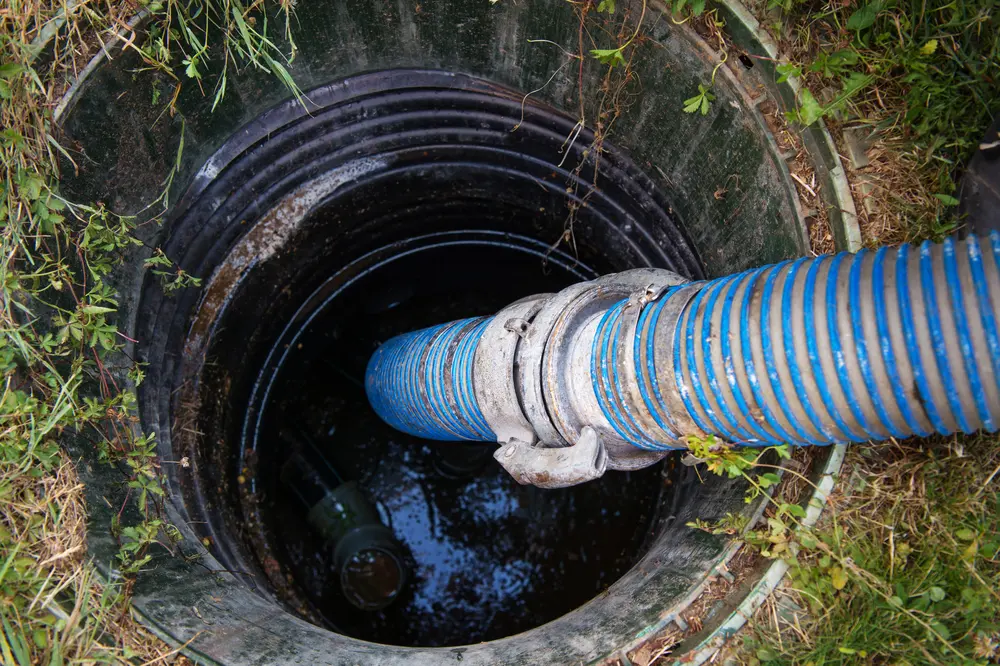
A tank that is never pumped does not fail all at once. Solids creep toward the outlet, clog the field, and turn a routine pump-out into a repair. We would rather see you for the pump-out.
When you need septic tank pumping
- The last pump-out was years ago, or nobody knows when it was.
- Drains slow down in more than one room at the same time.
- Toilets gurgle or the tub drains back up when the washer empties.
- You smell sewage near the tank lid or over the drain field.
- The ground over the tank stays wet after a dry week.
- You are buying or selling the house and the tank needs to be empty for an inspection.
- An aerobic inspection found too much sludge in the trash tank.
What we do on site
- Locate the tank and the lids. We find the tank and dig down to each lid if they are buried. Every compartment gets opened, not just the one that is easy to reach.
- Look before we pump. We note the liquid level and how thick the scum and sludge layers are. A tank that is full above the outlet tells us something different than a tank that is simply due.
- Pump every compartment. We pump liquid and solids until the tank is empty. On an aerobic system that means the trash tank, the aerobic chamber, and the pump tank as needed.
- Check baffles and walls. With the tank empty, we check the inlet and outlet baffles, the tank walls, and the lid seals. A missing outlet baffle lets solids slip out to the drain field.
- Watch the backflow. We note whether water runs back into the tank from the field or the house line once it is empty. Backflow from the field is an early sign the field is saturated.
- Close up and report. We seal the lids, clean up the area, and tell you what we saw. You leave with a plain answer about the tank and when to call again.
Septic tank pumping in Montgomery County
Most homes outside city limits here run on septic, and the clay under them drains slowly. When a tank goes too long between pump-outs, that clay field has less room to recover than sandy ground would.
Aerobic systems are common on these lots, and Texas requires an inspection at least once every four months under a maintenance contract. Those inspections often catch a trash tank that needs pumping, and we can handle both.
If your home is within 2,075 feet of Lake Conroe, the San Jacinto River Authority permitted your system, and its rules are stricter. Any repair we find during a lakefront pump-out has to meet those rules, so we tell you up front.
What affects the cost
- Tank size and how many compartments it has.
- How full the tank is and how packed the sludge layer has become.
- How deep the lids are buried and whether there are risers.
- Whether the system is aerobic or conventional.
- How far the truck has to park from the tank.
We own our licensed disposal facility, which keeps septic tank pumping costs down. Estimates are free, and we beat any written quote.
How to get ready
Before we arrive, hold off on laundry, the dishwasher, and long showers so the tank is not refilling while we pump. Clear a path from the driveway to the tank, and bring pets inside.
If you know where the lid is, mark it with a flag or a lawn chair. If you have a site drawing from the county or a past pump-out receipt, set it out.
After the pump-out, spread out laundry loads over the next few days. The tank refills with wastewater first, and that is normal.