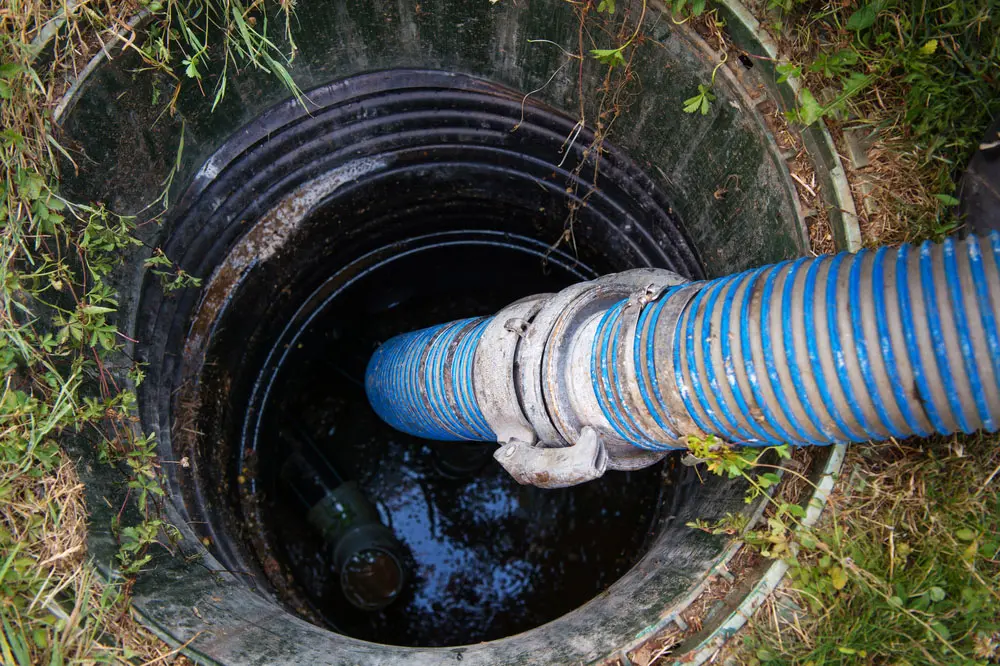
A tank that sat for years, or one that took grease from a kitchen, does not always come clean with suction alone. The hard layer stays stuck to the floor and walls, and the tank fills back up to the outlet faster than it should.
When you need septic tank cleaning
- The tank was pumped recently, but the drains are slow again.
- Nobody has opened the tank in years, and the sludge has likely set up.
- A kitchen sends grease, food scraps, or wipes down the drain.
- The effluent filter clogs again soon after it is rinsed.
- You are taking over a house that sat empty for a long time.
- An inspection noted heavy buildup around the inlet or outlet.
What we do on site
- Open and measure. We uncover every lid and measure how thick the sludge and scum layers are. Packed layers tell us a pump-out alone will leave solids behind.
- Break up the hard layer. We work the settled sludge and the grease cap loose so the vacuum can pull them out. This is the step that separates a septic clean out from a quick pump.
- Pump to the floor. We pump until the tank floor shows, not until the liquid level drops. What stays stuck to the walls gets worked loose and pulled out.
- Clean the filter and the openings. If the tank has an effluent filter, we pull it and clean it. We clear buildup around the inlet and outlet so water moves freely again.
- Check what the buildup was hiding. A clean tank lets us see cracks, loose baffles, and worn lid seals. We check them while the tank is open.
- Tell you what caused it. Heavy grease points to the kitchen, and fast sludge points to how often the tank is pumped. We tell you which one we saw so the buildup does not return.
Septic tank cleaning in Montgomery County
Many homes here sit on clay, which drains slowly and gives a drain field little room for error. When grease and fine solids leave a dirty tank, they seal the field faster than they would in sandy ground.
Aerobic systems add a trash tank ahead of the treatment chamber, and that tank catches most of the solids. A thorough septic system cleaning includes it, since a packed trash tank can push solids into the aerobic unit.
Aerobic systems in Texas must be inspected at least once every four months under a maintenance contract. If those reports keep flagging buildup, a full cleaning resets the tank.
What affects the cost
- How thick and how hard the sludge and grease layers are.
- Tank size and the number of compartments.
- Whether the tank has an effluent filter to clean.
- How deep the lids are buried and how far the truck parks.
- Aerobic or conventional system.
Because we own our licensed disposal facility, we keep the cost of hauling heavy solids down. Estimates are free, and we beat any written quote.
How to get ready
Stop running the dishwasher and laundry a few hours before we arrive. Clear a path to the tank, bring pets in, and mark the lid if you know where it is.
If the kitchen is the likely source, think about what goes down the sink before the visit. We ask so we can tell you whether the buildup is likely to return.
To stretch the time until the next cleaning, scrape plates into the trash and keep wipes and grease out of the drains. Then keep your pump-out schedule.